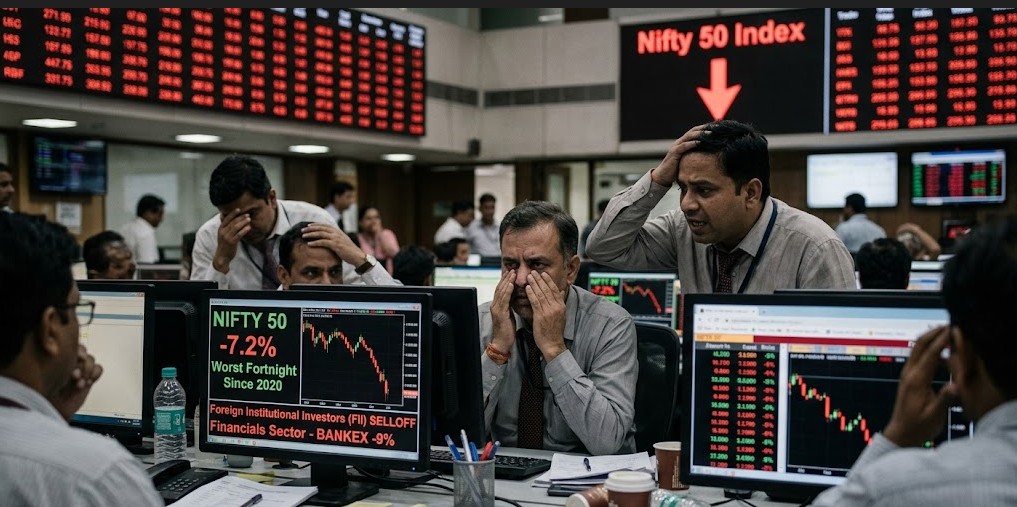
Indian equity markets just had their worst two weeks since the COVID crash of 2020. The Nifty 50 fell nearly 7%, the Nifty Bank index dropped 10%, and foreign institutional investors (FIIs) pulled out roughly ₹40,000 crore in a fortnight. Here's a clear breakdown of what drove it and what investors should be watching next.
What Caused the Selloff
Three triggers converged in the same two-week window:
1. RBI's hawkish signal. The Reserve Bank of India signalled its intention to maintain higher interest rates to control inflation. Higher rates compress bank margins and reduce the present value of future earnings — making financial stocks particularly vulnerable to a rerating.
2. FII rotation out of India. Foreign investors have been rotating capital out of Indian equities and back towards US and European markets, driven partly by a stronger dollar and partly by concerns about India's banking sector NPA levels. India's relatively high valuations compared to other emerging markets made it a target for profit-booking.
3. Rising NPA concerns. Analysts estimate the gross NPA ratio for Indian banks could approach 8% by fiscal year end — a level that raises questions about lending capacity and profitability. Public sector banks are more exposed here than private ones.
Which Sectors Were Hit Hardest
| Sector / Index | Approx. Decline (2 weeks) | Primary Reason |
|---|---|---|
| Nifty Bank | −10% | FII selling + NPA fears + rate sensitivity |
| Nifty Financial Services | −9% | Correlated with banking sector |
| Nifty 50 (overall) | −7% | Broad FII outflow |
| Nifty IT | −3–4% | Global tech sentiment, dollar impact |
| Nifty FMCG | −2–3% | Defensive sector, partial buffer |
What This Means for Retail Investors
For SIP investors, the straightforward answer is: do nothing. Market corrections are exactly the environment where SIPs work as intended — you buy more units at lower prices, which improves your average cost over time. Stopping or pausing a SIP during a correction is historically one of the worst moves retail investors make.
For lump-sum investors sitting on cash, this is the scenario where a dip-buying strategy (deploying capital at set percentage drops) becomes relevant. A 7% broad market correction with identifiable macro triggers — not a business collapse — is typically a buying opportunity for long-term investors, not a reason to exit.
The financial sector specifically warrants caution for stock-pickers. Individual banking stocks may face more downside if NPA ratios worsen further. A broad index fund or ETF is safer than individual bank stocks right now unless you have high conviction and a long time horizon.
What to Watch Next
📊 Key Triggers to Monitor
- RBI Monetary Policy Committee (MPC) meeting: Any dovish pivot — even just softer language — could spark a sharp relief rally in financials
- Q4 FY2026 bank earnings: NPA disclosures will determine whether the market's fears are priced in or still ahead
- US Federal Reserve policy: A Fed rate cut or pause strengthens the case for FII money returning to emerging markets like India
- FII flow data (weekly): Sustained buying from FIIs would be the clearest signal that the selloff is over
- Rupee vs Dollar: A stabilising or strengthening rupee reduces the currency risk that deters foreign investors
Frequently Asked Questions
Should I stop my SIP during this correction?
No. Corrections are when SIPs generate the most long-term value — you accumulate more units at lower prices. Stopping a SIP during a dip and restarting after recovery is how most retail investors underperform the index.
Is this the start of a bigger crash or just a correction?
The triggers here — FII rotation and RBI hawkishness — are macro factors, not structural business failures. Historically, India-specific macro-driven corrections recover within 3–6 months. That said, no one can predict with certainty. Diversification and a long time horizon are your best defences.