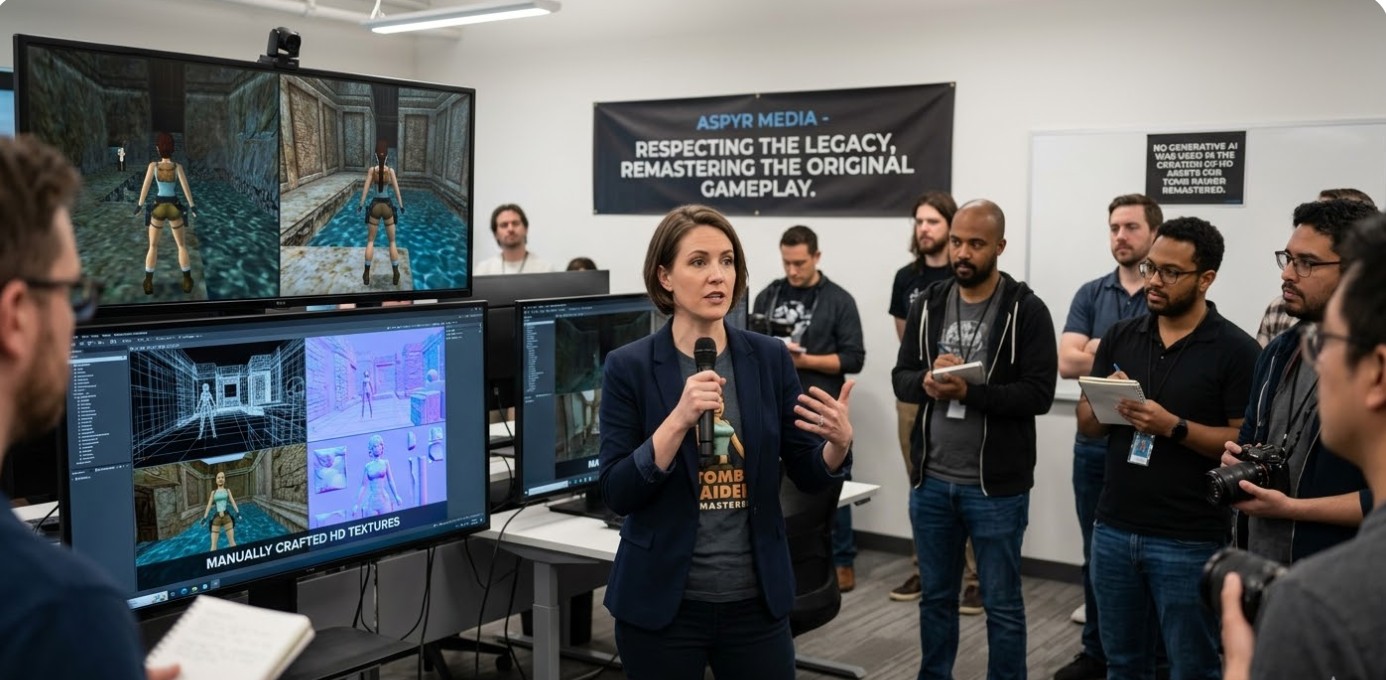
Days after launching Tomb Raider 1-3 Remastered on March 15, 2026, Aspyr found itself in the middle of a PR crisis that had nothing to do with bugs or performance. Players on Reddit and gaming forums were convinced parts of the remaster — textures, character models, dialogue — had been generated by AI. Aspyr denied it flatly. But the speed and ferocity of the accusation tells you more about the state of gaming in 2026 than the denial does.
What Players Flagged — and Why It's Complicated
The accusations centred on specific visual elements that players described as having an "uncanny valley" quality — textures that looked statistically smooth rather than intentionally crafted, background details that felt generic, and facial expressions in certain cutscenes that didn't match the emotional register of the original games. These are characteristics associated with AI-generated imagery, but they're also characteristics of rushed human work, aggressive compression, or upscaling from low-resolution originals.
Aspyr's core challenge with this remaster is that the source material dates from 1996–1998. The original assets were low-polygon models and low-resolution textures designed for hardware that no longer exists. Recreating those assets for modern displays requires either painstaking manual recreation or upscaling — and high-quality AI upscaling tools are now part of the standard workflow for remastering studios, even when no generative AI is used for new content creation. The distinction between "AI-assisted upscaling of original assets" and "AI-generated new content" is real and significant, but it's not a distinction players are necessarily equipped to make visually.
Why the Gaming Community Is Hypersensitive to AI Right Now
This controversy doesn't exist in isolation. It follows a string of incidents that have made the gaming community acutely suspicious of AI involvement in game development. Several studios have been caught using AI-generated concept art in marketing materials. Voice actors have raised alarms about synthetic voice cloning. The WGA strike brought AI content concerns into mainstream conversation. And DLSS 5's recent reception shows that even performance-enhancing AI can generate backlash when implementation is imperfect.
The result is a community primed to see AI where it may not exist. That's not irrational — given the incentives studios have to cut costs, scepticism is reasonable. But it creates a situation where any visual quirk in a remaster becomes potential evidence of AI involvement, regardless of the actual cause.
What This Means for Studios Going Forward
The Aspyr situation is a preview of the communications problem every game studio now faces. Even if no generative AI was used, the perception of AI use can generate the same reputational damage as actual use. Studios that don't proactively communicate their development methodology — what tools were used, what was human-created, where AI assistance (if any) played a role — are leaving themselves exposed to exactly this kind of controversy.
The most credible response isn't just denial. It's transparency upfront: behind-the-scenes developer content showing the human artists at work, explicit statements in pre-launch communications about AI policy, and a clear position on what "AI tools" the studio does and doesn't use in its pipeline. Aspyr responded reactively. The studios that come out of this era with intact trust will be the ones that get ahead of the question before launch.
The Broader Lesson
Whether or not Aspyr used AI is almost secondary. The incident demonstrates that player trust in game studios around AI is fragile and declining. Studios that don't proactively address this will face more of these controversies — regardless of what they actually do in development.
Key Takeaways
- Aspyr denied using generative AI in Tomb Raider 1-3 Remastered — all content was human-created per the studio's statement
- The visual characteristics players flagged can result from human work on original low-res assets, not only from AI generation
- Gaming community AI scepticism is at an all-time high following WGA strikes, voice cloning concerns, and AI marketing art controversies
- Studios need proactive AI transparency communications — reactive denial after a controversy has already erupted is the worst position to be in
Frequently Asked Questions
Q: Did Aspyr use generative AI in Tomb Raider 1-3 Remastered?
A: Aspyr has categorically denied this. The studio stated all content was created by human artists. There is no independent verification either way — the studio's denial is currently the only official account.
Q: Is it possible to tell if a game used generative AI from the visuals?
A: Not reliably. The visual characteristics associated with AI generation — over-smooth textures, generic detail, certain artefacts — can also result from human work constrained by time or budget, or from AI-assisted upscaling of original assets that isn't the same as AI-generated new content. Visual analysis alone cannot definitively prove AI involvement.
Q: Are other game studios using generative AI in development?
A: Yes, openly in some cases. Several studios have confirmed using AI tools for concept art generation, dialogue prototyping, and QA testing — with varying degrees of transparency about extent and application. The industry lacks a consistent disclosure standard, which is part of why player suspicion runs high.